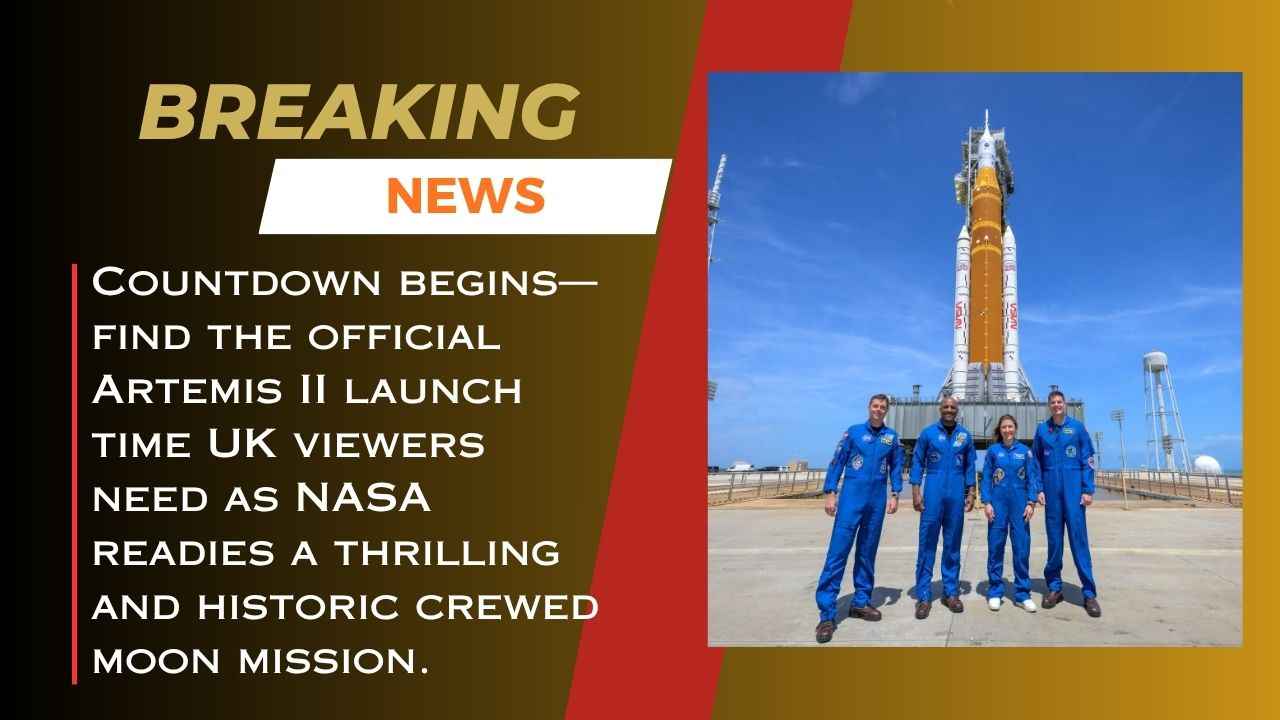

NASA is all set to make history with the launch of its first crewed mission to the Moon – Artemis II in more than 50 years. The launch is scheduled for 1st April 2026, which would mark a major milestone in space exploration. As per the latest report, the launch will take place at 6:24 p.m. EDT (eastern time) from Kennedy Space Centre in Florida. UK viewers can watch the event at 11:24 p.m. UK time (BST).
It is also confirmed that there will be a two-hour launch window by NASA that would allow flexibility in case of minor delays. Under NASA’s Artemis program, Artemis II is a landmark mission that would aim to return people to the Moon and pave the way for missions to Mars eventually. It will be the first time astronauts will travel beyond low Earth orbit since the 1970s (Apollo era).
This mission will take 4 astronauts on a 10-day journey around the Orion spacecraft that will be powered by NASA’s Space Launch System (SLS) rocket. These astronauts are Victor Glover, Reid Wiseman, Jeremy Hansen and Christina Koch.
The most significant factor is that the mission will not land on the moon but will perform a free return trajectory that would loop around the far side of the Moon prior to returning to Earth. This will allow NASA to test important systems like navigation, life support and deep-space communication.
The Artemis II mission is a critical test flight, and it’s more than a symbolic return. The mission carries a historic significance in terms of representation. Engineers would monitor how the spacecraft acts with a human on board in deep space, particularly after minor issues observed during the uncrewed Artemis I mission. The mission includes the first woman and the first person of colour to travel to the vicinity of the moon, along with the first Canadian Astronaut on a mission.
As per the NASA report, nearly 80% of chances indicate favourable weather, even though conditions like cloud and wind will remain the key factors that may cause a delay in liftoff. Final launch preparations, like three quantiles and rocket rollout, have been completed while mission teams monitor in detail closely to ensure success and safety. All eyes are on 1st April 2026 as the world will prepare a new beginning in space exploration, life from Florida and late at night in the United Kingdom.