

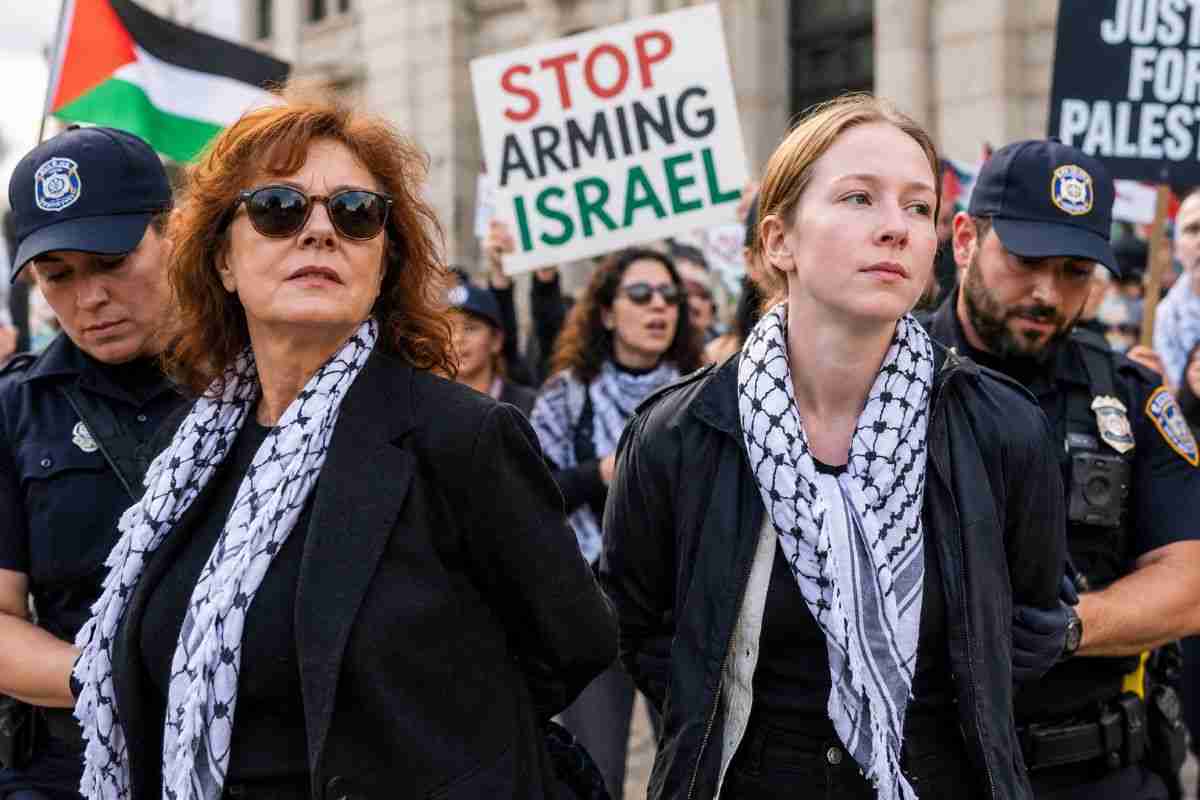
Susan Sarandon and Hacks star Hannah Einbinder were among protesters taken into custody in New York on Thursday as demonstrators gathered outside the United Nations ahead of Benjamin Netanyahu’s address to the General Assembly. Videos showing the two actors being led away in handcuffs quickly spread online, raising a straightforward question: were they arrested simply for protesting, or was something else involved?
The available reporting indicates that the arrests were connected to the demonstration and the protesters’ actions at the site, rather than simply to their political views. (Internazionale)
What’s actually true
The protest took place on 24 September 2026 near the UN headquarters in New York. Demonstrators opposed Netanyahu’s appearance at the General Assembly and called for an end to the war in Gaza and US military support for Israel.
Reuters reported that at least 30 people were arrested, including Sarandon, Einbinder, New York City Council member Chi Osse and congressional candidate Darializa Avila Chevalier. Other reports put the number of people taken into custody considerably higher, but those figures came from organisers or other reports and were not immediately confirmed by the NYPD. (Internazionale)
Video and photographs show Sarandon and Einbinder being restrained and escorted away by NYPD officers. Einbinder was heard chanting “Free Palestine” and “Netanyahu out of New York” as she was taken away. (TheWrap)
The demonstration involved protesters sitting in and blocking a street close to the UN. That distinction matters because US constitutional protection for peaceful protest does not mean every action carried out during a demonstration is automatically lawful.
The NYPD’s own guidance says officers must respect First Amendment rights to free speech and peaceful assembly while also taking enforcement action where unlawful activity occurs. (NYC Government)
Why were protesters arrested if protest is protected?
This is the key point behind much of the confusion online.
The First Amendment protects Americans’ rights to express political views and peacefully assemble. It does not provide a blanket exemption from laws governing traffic, obstruction, property damage, violence or other unlawful conduct.
New York City’s published protest procedures specifically require officers to balance freedom of expression with public safety. The NYPD has also previously described a tiered approach under which peaceful demonstrations can be accommodated, while police can intervene when there is probable cause that individuals have committed offences or when critical infrastructure is being blocked. (NYC Government)
That means being arrested at a protest does not, by itself, establish that someone’s political speech was illegal. Equally, the fact that someone was protesting peacefully does not automatically mean every circumstance surrounding their arrest was unlawful.
The precise charges and legal outcomes for individual protesters can differ and should not be assumed from photographs or short social-media videos.
What does this mean for the wider protest debate?
The arrests have renewed attention on a question that extends well beyond Sarandon and Einbinder: where is the line between protected political protest and unlawful disruption?
New York authorities had already warned ahead of Netanyahu’s visit that the UN General Assembly would bring increased demonstrations. Police Commissioner Jessica Tisch said the NYPD was prepared to facilitate First Amendment activity while stressing that violence, property destruction and breaking the law would not be tolerated. (NYC Government)
The episode therefore illustrates an important distinction often lost in viral posts: a protest can be politically protected while particular conduct during that protest can still lead to police enforcement.
Common misconceptions
- “They were arrested because they criticised Netanyahu.”
The available reporting does not establish that. The arrests occurred during a demonstration in which protesters were blocking a street near the UN. (Internazionale) - “If police arrest someone, they have been found guilty.”
No. An arrest is not a criminal conviction. What happens afterwards depends on the individual case and any charges brought. - “A celebrity receives special legal protection at a protest.”
There is no indication of such an exemption. Sarandon and Einbinder were treated as protesters during the police operation. - “Being handcuffed proves the person committed a serious crime.”
Not necessarily. Images of someone being restrained do not establish the eventual charge, whether charges were pursued, or the outcome of a case.
What happens next?
The important developments to watch are the official NYPD account, any charges filed, court records and statements from the protesters or their representatives.
For readers following the story from the UK, it is also worth remembering that American protest and arrest rules are based on US law and the First Amendment. They should not automatically be treated as an explanation of how a similar demonstration would be handled under UK law.
For now, the confirmed picture is that Sarandon and Einbinder were among protesters arrested during a demonstration outside the UN on 24 September. The wider political arguments surrounding Netanyahu, Israel, Gaza and the protest itself remain deeply contested, but the immediate legal question is narrower: what conduct led to each arrest, and what happens in each case afterwards?
