

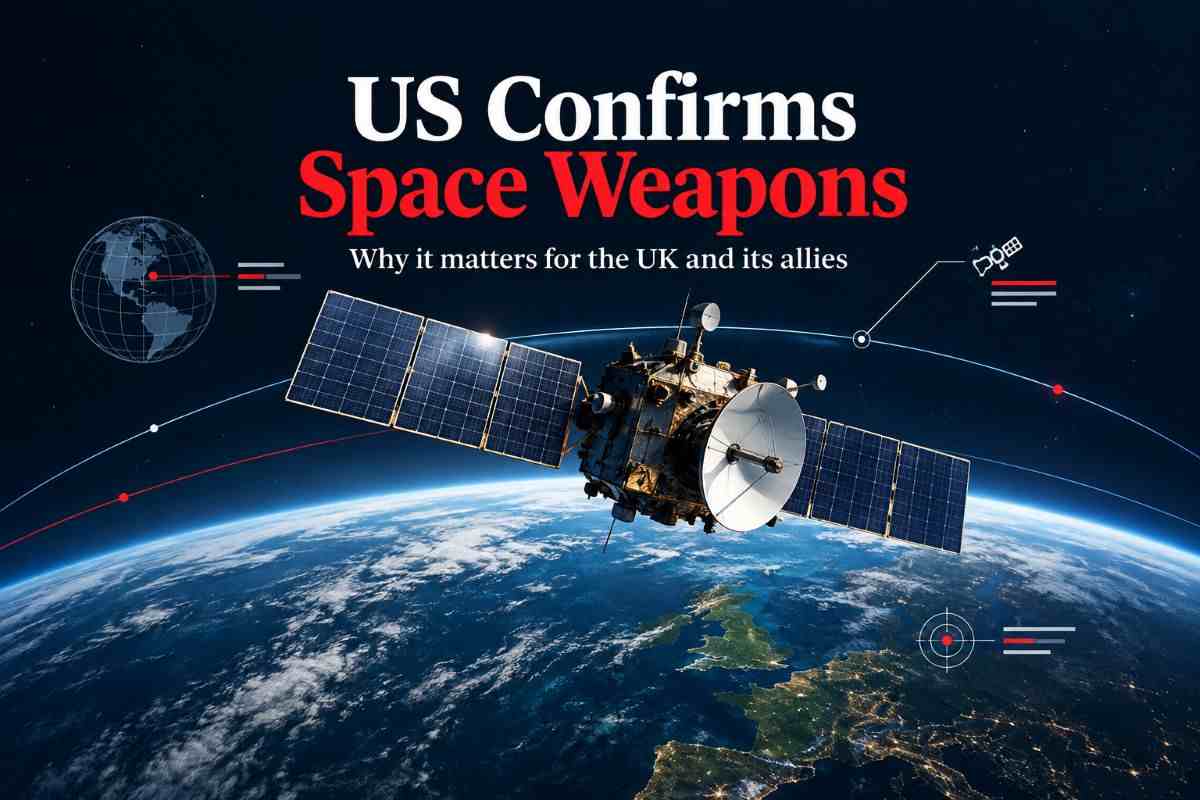
The United States has publicly acknowledged for the first time that it has weapons deployed in orbit, raising an obvious question: does this mean space is becoming a battlefield, and could ordinary people in the UK be affected?
The announcement is significant, but it does not mean that missiles are suddenly being fired between satellites. The US has revealed the existence of “on-orbit space control weapons”, while keeping their exact capabilities secret. (AP News)
What’s actually true?
US Air Force Secretary Troy Meink disclosed at the Air and Space Forces Association’s Air, Space & Cyber Conference in Maryland on 14 September 2026.
He said the United States now has “on-orbit space control weapons” capable of defending the Joint Force against hostile adversary action. The US military has not publicly identified the systems, how many there are, when they were deployed or precisely what targets they are designed to affect. (The Washington Post)
The term “space control” is important. It covers capabilities intended to affect an adversary’s ability to operate in space. These can include technologies that interfere with, disrupt or otherwise affect another country’s space assets.
That is different from the popular image of nuclear missiles permanently orbiting Earth.
The 1967 Outer Space Treaty prohibits placing nuclear weapons and other weapons of mass destruction in orbit, but it does not create a blanket prohibition on every military capability in space. It also prohibits military bases and weapons testing on the Moon and other celestial bodies. (UNOOSA)
So the headline “weapons in space” should not automatically be interpreted as “nuclear weapons in space”.
Why is the US revealing this now?
Washington has increasingly described space as a contested military environment, pointing to counterspace capabilities being developed by China and Russia. US Space Force documents say those countries are developing systems capable of disrupting or degrading American space capabilities. (U.S. Space Force)
The US says its own orbital weapons are intended to help defend its forces and space infrastructure. Space Force chief General Douglas Schiess has also described the disclosure in terms of deterrence — making potential adversaries aware that the US can respond if its space assets are attacked. (U.S. Space Force)
China and Russia have criticised the development, with concerns that greater military activity in orbit could contribute to an arms race. (CBS News)
What does this mean for people in the UK?
For most people, there is no immediate practical action to take.
But the issue matters because modern Britain relies heavily on satellites. They support communications, navigation, financial systems, weather monitoring, emergency services and defence.
The UK’s new Space Strategy, published in September 2026, explicitly describes space as increasingly contested and sets out plans to strengthen protection of UK interests and critical space infrastructure. The government also identifies satellite communications and positioning, navigation and timing as priorities. (GOV.UK)
That means a serious conflict involving satellites could eventually have consequences on Earth — potentially affecting communications, navigation or other services that depend on space infrastructure.
That is a potential risk, not evidence that UK services are currently under attack.
Common misconceptions to avoid
“The US has put nuclear weapons in orbit.”
That has not been established by the announcement. The specific weapons have not been publicly identified, while the Outer Space Treaty prohibits nuclear weapons and other weapons of mass destruction in orbit. (UNOOSA)
“Space has suddenly become militarised.”
Military use of space is not new. Satellites have supported communications, surveillance, navigation and other military functions for decades. The significant development is the US publicly acknowledging deployed orbital weapons.
“A space weapon means a satellite will be destroyed.”
Not necessarily. “Space control” can involve different technologies and effects, and the US has not disclosed the exact systems involved.
What happens next?
The most important developments to watch are whether Washington provides further details about the weapons, how China and Russia respond, and whether other governments announce new counterspace capabilities.
For UK readers, the practical lesson is simpler: don’t confuse a major change in military policy with an immediate threat to everyday life.
The UK is already strengthening its ability to monitor activity in orbit and protect satellite-dependent infrastructure. Its latest strategy also emphasises working with NATO allies, including the United States, on space security. (GOV.UK)
Key takeaways
- The US has publicly confirmed that it operates weapons in orbit.
- The exact weapons and their capabilities remain classified or undisclosed.
- The announcement does not establish that nuclear weapons are being placed in orbit.
- The US describes the systems as part of its ability to defend against hostile activity in space.
- Britain is also increasing its focus on space security because satellites support important civilian and defence services.
- There is no indication from this announcement alone that UK consumers need to change their normal behaviour.
