

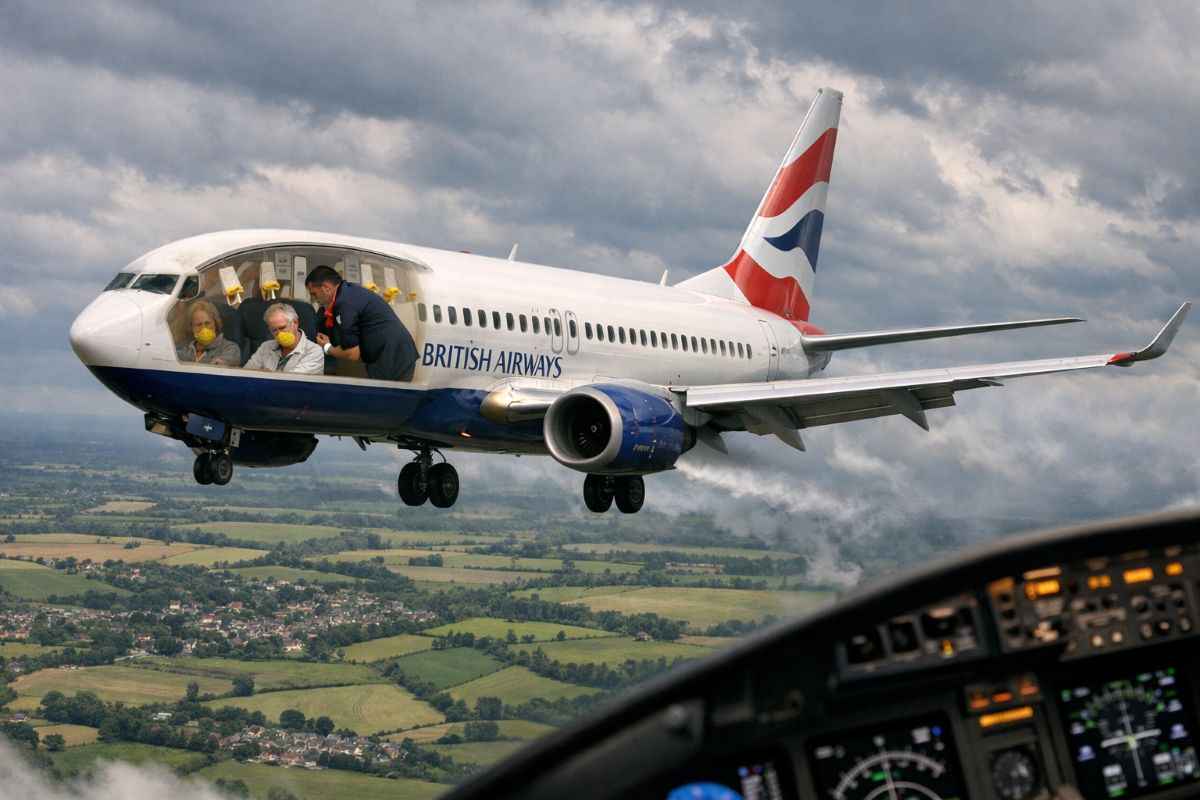
A British Airways flight from Dublin to London Heathrow triggered an emergency alert while flying over north-west England, followed by a controlled descent that naturally left passengers and people watching the aircraft’s flight path wondering what had gone wrong.
The important detail is what happened next: BA825 continued towards Heathrow at a lower altitude and landed safely. British Airways said the incident was caused by a minor technical issue, although the airline has not publicly identified the specific fault.
What’s actually true
Flight BA825, an Airbus A321neo, departed Dublin on 1 September and was approaching England when its crew selected the 7700 transponder code.
That number can sound alarming when it appears on flight-tracking websites. It is, however, an established aviation emergency code. UK Civil Aviation Authority guidance says pilots should select 7700 when an aircraft is experiencing an emergency, allowing air traffic services to identify the situation and provide appropriate assistance.
Tracking data showed the aircraft subsequently descended to around 8,000 feet, stabilised and continued towards Heathrow. Emergency services were placed on standby at the airport, which is a normal precaution when an aircraft declares an emergency. The aircraft later landed safely, and passengers disembarked without reported injury.
What remains unclear is the exact nature of the technical problem. Reports have speculated about possibilities including pressurisation or other aircraft systems, but British Airways has not confirmed the specific fault. Those possibilities should therefore not be presented as facts.
Why would a plane suddenly descend?
An emergency descent is not necessarily an uncontrolled plunge.
In aviation, a rapid or emergency descent is a deliberate procedure used when remaining at cruising altitude could be unsafe. For example, a pressurisation problem can require an aircraft to descend quickly to an altitude where passengers and crew can breathe more easily.
UK aviation procedures specifically provide for emergency descents following sudden decompression or a malfunction requiring the aircraft to descend. Pilots are expected to inform air traffic control, use the emergency transponder code and coordinate what happens next.
That distinction matters because dramatic-looking flight-tracking data can give the impression that an aircraft is falling out of the sky. In reality, a controlled descent is a recognised safety procedure carried out by trained flight crews.
What does the 7700 code actually mean?
One common misconception is that seeing 7700 means a crash is imminent.
It does not.
The code tells controllers that the crew is dealing with an emergency, but it does not reveal what the emergency is. It can therefore cover a range of circumstances requiring priority assistance.
The CAA’s guidance also makes clear that declaring an emergency early can be the prudent option. Pilots are encouraged to declare when in doubt because an emergency can subsequently be cancelled if the situation is resolved.
For passengers, that means the appearance of 7700 on a tracking app should not be interpreted as a diagnosis of what has happened inside the aircraft.
What should passengers do if this happens on their flight?
The best response is surprisingly simple: follow the cabin crew’s instructions.
If an emergency descent is taking place, passengers may be asked to remain seated, fasten their seat belts and, depending on the circumstances, use oxygen masks. The aircraft’s procedures are designed around getting it to a safer altitude and then deciding whether to continue, divert or land.
Aircraft operating under UK rules are also subject to requirements covering supplemental oxygen in the event of cabin pressurisation problems. The precise equipment and procedures vary by aircraft and operation.
Passengers should therefore avoid trying to interpret every movement of the aircraft themselves. Flight-tracking apps provide useful information, but they do not show the crew’s full technical picture or the decisions being made in the cockpit.
What happens after an emergency landing or precautionary arrival?
A safe landing does not necessarily mean the aircraft immediately returns to service.
An aircraft may be taken to a remote stand or otherwise separated from normal passenger operations so engineers can inspect it. That is what happened with BA825, which was taken to a remote stand at Heathrow after landing.
Any further technical findings would need to come from British Airways or, where appropriate, the relevant aviation safety authorities. The UK’s Air Accidents Investigation Branch maintains records of investigations and serious incidents, although not every technical event automatically becomes an AAIB investigation.
The key takeaway
The BA825 incident was a genuine in-flight emergency, so it should not be dismissed as nothing. But the available evidence also does not support interpreting the descent as an uncontrolled fall or assuming the aircraft was on the verge of crashing.
The crew declared the emergency, descended in a controlled manner, continued to Heathrow and landed safely. British Airways has described the underlying problem as minor, while the precise technical cause remains unconfirmed.
For anyone concerned after seeing the incident online, the most important lesson is to distinguish between an emergency procedure and an aircraft accident. They are not the same thing.
