

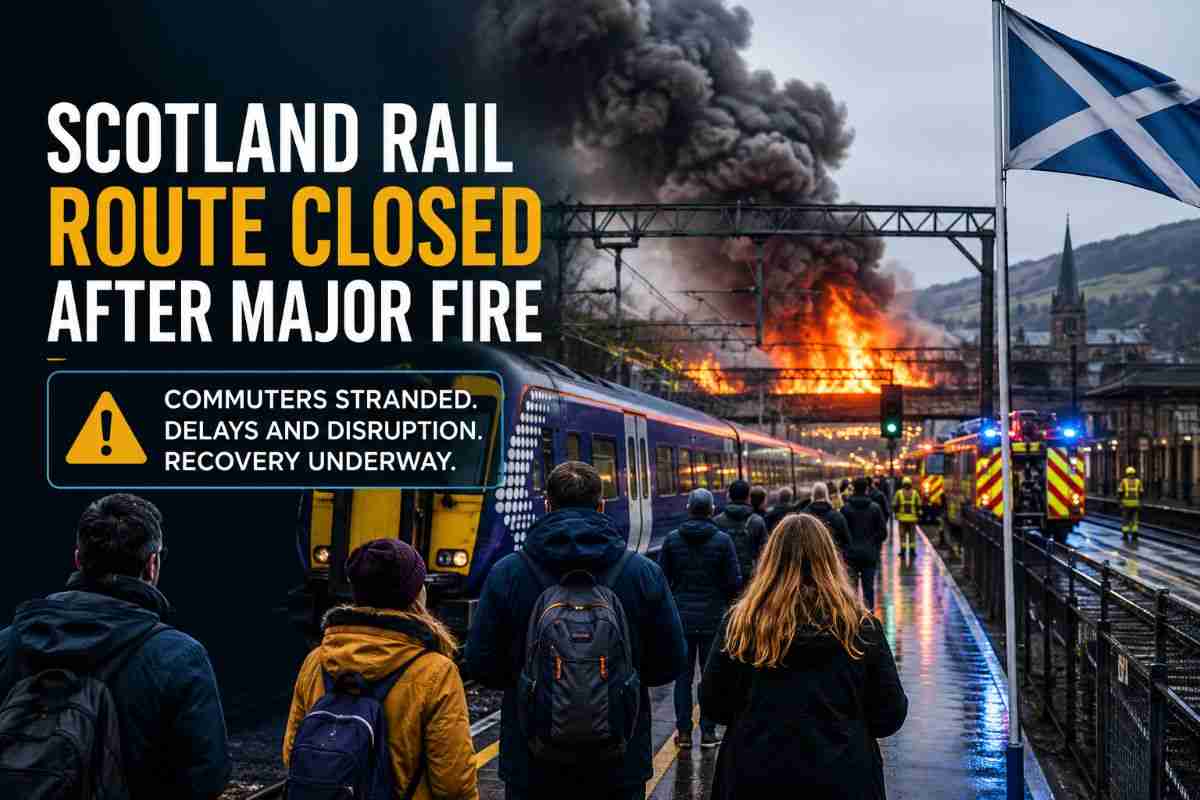
A fire beside a busy railway line in Scotland brought rail travel to a standstill, leaving hundreds of passengers facing cancellations, delays and uncertain journeys. For many commuters, the disruption raised an immediate question: how can a fire near the tracks shut down an entire rail route, even if the railway itself is not burning?
The short answer is safety. While the disruption can feel frustrating, rail operators are required to stop services whenever a fire threatens tracks, signalling equipment or overhead power lines until engineers are satisfied it is safe to resume operations. (The Scottish Sun)
What’s actually true
The latest disruption affected the route between Craigendoran and Cardross on the Helensburgh–Edinburgh line after a fire broke out close to the railway. Emergency crews attended the scene, and train services were suspended while firefighters tackled the blaze and railway staff inspected the infrastructure. Once the fire was brought under control, services gradually resumed, but passengers were warned to expect continued delays as trains and crews returned to their normal positions. (The Scottish Sun)
Although the flames may not have reached the rails themselves, nearby fires can create several hazards.
Smoke can reduce visibility for train drivers, while intense heat may damage signalling equipment, cables or overhead electric wires. Firefighters also need unrestricted access to work safely, making it impractical—and often unsafe—for trains to continue operating through the affected area.
That is why operators typically suspend services first and assess the damage afterwards rather than risk passengers or railway staff.
How this connects to travel disruption and passenger rights
For many travellers, the bigger concern is what happens after services stop.
When unexpected incidents such as fires disrupt rail travel, operators often introduce temporary timetables, diversionary routes or replacement buses where possible. Depending on the circumstances and the train company involved, passengers may also qualify for ticket refunds or delay compensation if their journey is significantly affected. Official guidance is normally published through train operators’ websites, apps and station announcements as the situation develops. (The Scottish Sun)
The incident also highlights how vulnerable parts of Britain’s rail network can be to events occurring outside railway property. Fires in nearby buildings, vegetation or adjacent land have caused significant disruption in the past, including major closures around Glasgow Central and other Scottish routes while engineers ensured infrastructure remained safe. (ScotRail)
Common misconceptions
One common assumption is that if the tracks look undamaged, trains should continue running.
In reality, railway safety decisions are based on far more than visible damage. Hidden electrical faults, weakened overhead equipment, damaged signalling systems or emergency service operations can all make it unsafe to operate trains.
Another misconception is that operators cancel services simply as a precaution. In practice, Network Rail, emergency responders and train operators follow established safety procedures before allowing services to restart. Even after a fire is extinguished, inspections can take time before passengers are allowed back onto trains. (The Scottish Sun)
What to do next
If your journey is affected by a similar incident:
- Check live journey information before travelling through your train operator’s website or app.
- Listen for announcements about replacement buses or alternative routes.
- Keep your ticket until your journey is complete, as it may be needed for compensation or refund claims.
- Allow extra travel time, as delays can continue after services officially restart.
- If your travel is essential, verify the latest updates through official railway channels rather than relying solely on social media posts.
Key takeaways
The latest Scottish rail disruption was caused by a fire near the railway rather than on the tracks themselves, but that distinction makes little difference to passenger safety. Fires close to rail infrastructure can threaten signalling, electrical equipment and emergency operations, meaning services must be suspended until engineers confirm the route is safe.
For commuters, the most practical approach is to monitor official travel updates, expect disruption to continue even after trains begin moving again, and check whether you’re eligible for refunds or compensation if your journey is delayed.
